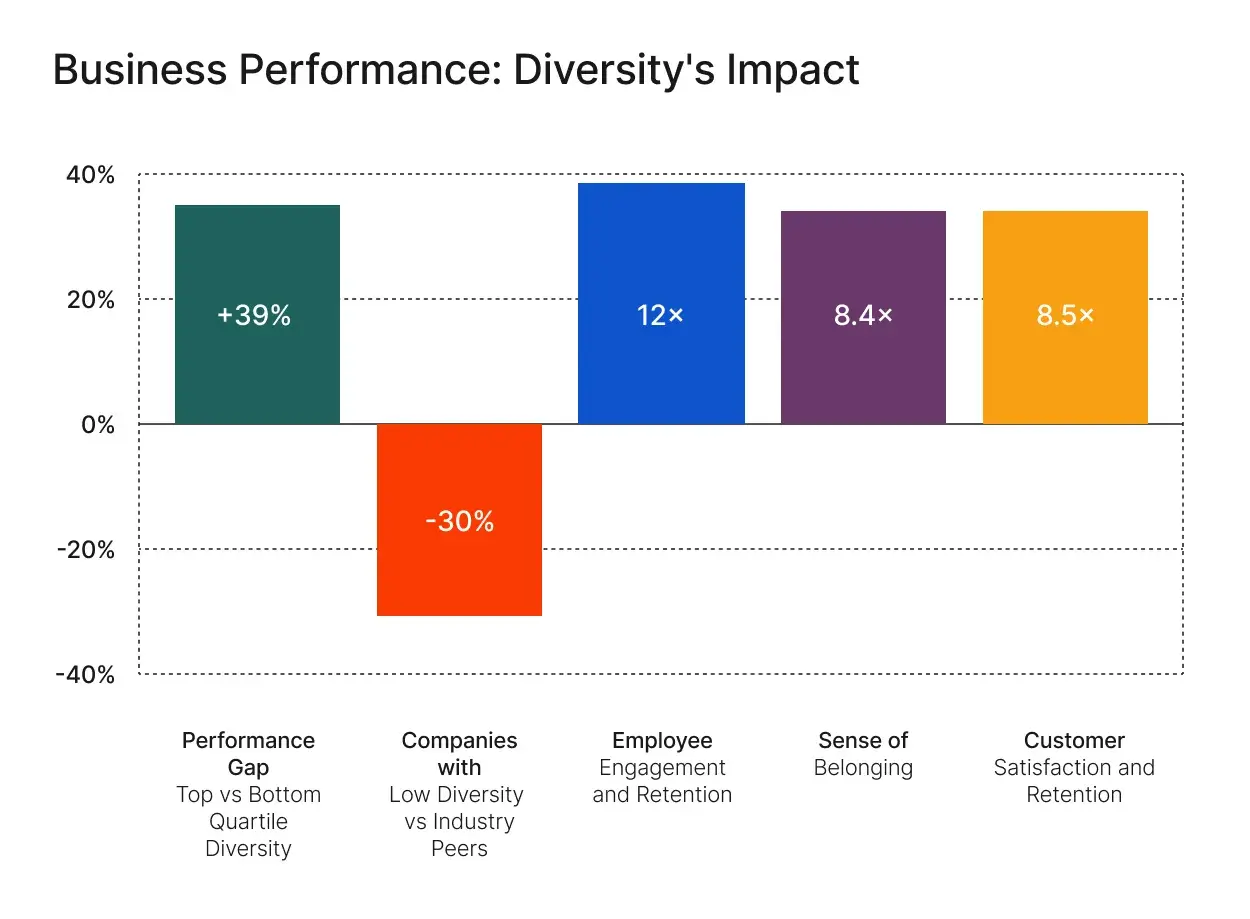
What matters most when diversity has to deliver results
- Diverse teams improve judgment when they have room to challenge each other honestly.
- In the UK public sector, inclusion is tied to legal duties as well as better delivery.
- Recruitment alone rarely changes outcomes; everyday processes decide whether people influence decisions.
- Measurement should cover representation, progression, retention, and service impact.
- The strongest gains appear when diversity work is connected to citizen outcomes, not internal branding.
What diversity really means in public service work
When I talk about diversity, I mean more than visible demographics. In a public sector setting it also includes socioeconomic background, disability, geography, caring responsibilities, professional training, language, and the way people approach problems.
That matters because two people can look similar on paper and still see a service very differently. A frontline nurse, a policy analyst, a procurement lead, and a local government administrator may all sit in the same meeting, but each brings different blind spots and different instincts about what will fail in practice.
A useful way to think about it is this:
- Representation answers who is in the room.
- Diversity of thought answers what ideas are possible.
- Inclusion answers whether those ideas can actually shape the outcome.
Without the third piece, diversity can look good in a slide deck and still leave decision-making narrow. That distinction matters even more in government, where the people affected by a decision often have no easy way to opt out. That is why the public sector feels the effects of inclusion, or its absence, so sharply.
Why public sector teams feel the benefit more sharply
Public services do not serve a narrow customer base. They touch children, older adults, disabled people, carers, jobseekers, business owners, migrants, and communities with very different levels of digital access and confidence. A design choice that seems minor to one group can become a real barrier for another.That is one reason GOV.UK’s Equality Act guidance frames the Public Sector Equality Duty around three aims: eliminate discrimination, advance equality of opportunity, and foster good relations. Those aims are not decorative. They force leaders to ask who benefits, who is burdened, and who is likely to be overlooked when a policy, procurement decision, or service model goes live.
I see the same pattern in everyday service design. A form that assumes stable internet access. A consultation that only rewards confident speakers. A deadline that ignores shift work or caring responsibilities. Each of those choices can create avoidable exclusion even when the policy intention is sound.
GOV.UK’s public policy design guidance makes a similar point: a broader workforce is more likely to surface different voices and differential impacts before they are baked into delivery. In other words, diversity is not just about fairness inside the organisation; it is also about better decisions for the public outside it.

The gains that matter most day to day
The benefits are easiest to spot when you look at how teams actually work under pressure. I care less about slogans than about whether a team spots risk early, debates properly, and makes a decision that still holds up after challenge.
| Benefit | What changes in practice | What it looks like when it works |
|---|---|---|
| Better decisions | People test assumptions instead of rushing to consensus. | Meetings end with fewer hidden objections and stronger follow-through. |
| Sharper risk spotting | Different backgrounds reveal gaps in process, access, and communication. | Problems are found before they become complaints, delays, or legal issues. |
| More relevant services | Teams design for varied users, not just the most familiar one. | Forms, letters, digital journeys, and appointments are easier to use across groups. |
| Higher engagement | People are more likely to stay when they feel seen and respected. | Turnover falls, internal challenge rises, and managers hear bad news earlier. |
The point is not that a mixed team magically produces the right answer. The point is that it has a better chance of seeing the wrong answer before it is embedded in policy or service design. In public life, that is a material advantage. It saves time, reduces rework, and usually saves money too, because fixing preventable failure is always more expensive than avoiding it.
When that advantage is missing, you often notice it first in the quality of disagreement. Silence in a meeting can look like efficiency, but in practice it often means the room is too uniform or too cautious. That is where the problems start.
Where good intentions break down
The biggest mistake I see is treating representation as the finish line. A team can recruit more widely and still reproduce the same hierarchy if the dominant culture decides who speaks, who gets credit, and whose concerns are treated as serious.
- Tokenism happens when one person is asked to carry the burden of an entire group’s perspective.
- Assimilation happens when people are welcome only if they sound and behave like everyone already in power.
- Culture fit becomes a shortcut for sameness when it is used without clear, job-related criteria.
- Psychological safety is missing when people do not believe they can raise a disagreement without harm to their reputation or career.
That last point matters more than many leaders admit. If people cannot challenge a proposal, a risk register or an equality impact assessment will not rescue the project later. The information simply never reaches the table in time.
Another failure is over-investing in training while leaving processes untouched. Training can help, but it cannot fix an opaque promotion process, inaccessible meetings, or a decision-making style that rewards the loudest voice. If the system stays the same, behaviour usually snaps back to the old norm.
How leaders can build inclusion that sticks
GOV.UK’s project delivery guidance is refreshingly direct here: build equality, diversity, and inclusion into working practices, listen to different voices, and trust people to deliver. I would translate that into a few habits that managers can use immediately.
- Redesign hiring for evidence, not familiarity. Use structured interviews, clear scoring, and skills-based criteria. If a role depends on judgement or stakeholder work, ask candidates to show how they have handled complexity rather than relying on polished generalities.
- Make meetings easier to contribute to. Send papers in advance, state the decision required, and ask for written input as well as spoken input. In hybrid settings, I would also watch who is interrupted, who is summarised, and who is never asked a follow-up question.
- Build progression pathways, not just entry points. Sponsorship, transparent promotion criteria, and regular talent reviews matter because diversity often leaks out at mid-level and senior level. Entry-level gains do not survive if advancement is opaque.
- Use service-user insight early. Public sector teams should involve frontline staff and the people affected by a service before the design is fixed. Co-design is slower at the start, but it reduces expensive rework later.
- Audit language and systems. Forms, guidance, recruitment copy, and performance frameworks can quietly exclude people. Remove jargon, test accessibility, and check whether policy language assumes a single household pattern, a single work pattern, or a single way of communicating.
- Tie inclusion to a visible objective. If leaders do not measure anything, attention drifts. A concrete objective keeps the work attached to delivery instead of turning into an annual campaign.
If I had to prioritise one shift, I would start with decision-making rather than training. A team that changes how it hires, briefs, and reviews work will improve faster than a team that attends workshops but keeps the same power dynamics. That is the practical bridge to measurement, because progress should show up in data as well as in tone.
How to measure whether the work is paying off
I do not trust a diversity dashboard that stops at headcount. Representation matters, but it is only one part of the picture. If the same groups are still stalled in progression, leaving sooner, or shouldering more criticism for the same work, the organisation has not really changed.
| Measure | What it tells you | What can mislead you |
|---|---|---|
| Representation by grade and function | Who is present, and whether senior roles are becoming broader. | Good headline numbers can hide bottlenecks at middle management. |
| Hiring and promotion rates | Whether access to opportunity is widening. | More applicants do not matter if shortlists and promotions stay narrow. |
| Retention and exit patterns | Whether people are staying long enough to grow. | Low turnover can still hide quiet disengagement or stalled careers. |
| Employee voice and speaking-up data | Whether people feel safe to challenge or raise risk. | High survey scores can mask subgroup differences if results are averaged too broadly. |
| Service outcomes by user group | Whether the public sees better access, fairness, or satisfaction. | Overall satisfaction can rise while one group is still underserved. |
| Equality objectives and impact reviews | Whether the organisation is tracking its legal and operational commitments. | Objectives that are vague or unmeasured create activity without accountability. |
In England, public bodies subject to the specific duties must publish at least one equality objective every four years. I like that requirement because it stops the work drifting into vague intention. A good objective should be specific enough that a leader can say, within months, whether the organisation is moving or simply talking.
That kind of measurement also protects the work from becoming performative. It keeps the focus on outcomes, which is where the real test always sits.
What I would keep in view after the first gains
The real value of diversity is not that it makes an organisation look broader; it is that it improves judgment where judgment matters most. In public sector work, that means better policy, better services, and fewer preventable blind spots.
If I were advising a leader in 2026, I would keep the next step simple: pick one service, one team, and one decision process, then ask who is missing, who is silent, and which assumptions nobody has tested yet. The answer to those three questions usually tells you where the work needs to begin.
When diversity and inclusion are treated as part of how work gets done, rather than as a separate programme, the gains tend to stick. That is the version of the issue that actually changes public value, and it is the version worth investing in.